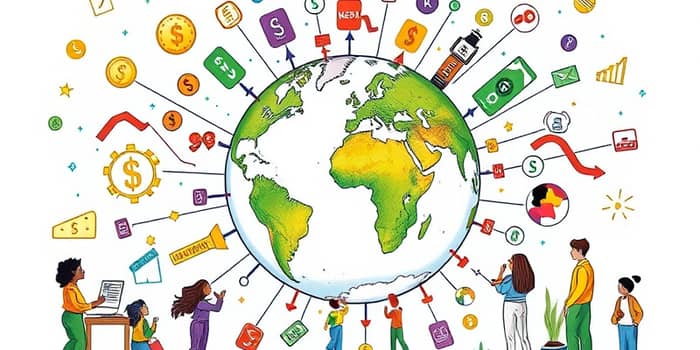
In an era where capital flows seamlessly across continents, international financial systems are undergoing unprecedented transformation. From record-breaking bank revenues to revolutionary digital currencies, the landscape of global finance is being rewritten daily. This article explores the drivers of this change and offers insights into harnessing these trends for sustainable growth.
Transformative Growth in the Global Banking Sector
Over the past five years, the global banking system has charted remarkable expansion, reflecting a robust appetite for credit and investment worldwide. Between 2019 and 2024, funds intermediated by the global banking system surged by $122 trillion, outpacing GDP growth by a substantial margin.
In 2024 alone, banks recorded a record $5.5 trillion in revenue after accounting for risk costs. Net income soared to $1.2 trillion, marking the highest profitability ever achieved by any industry. Retail and institutional funds management also thrived: retail assets grew at 6.0 percent annually, while institutional portfolios expanded by 7.7 percent each year.
The private capital sector emerged as a powerhouse, with expansion rates hitting 17.2 percent annually. This trend underscores private capital’s rising influence in global markets, drawing both institutional investors and high-net-worth individuals seeking diversified returns.
Digital Innovation and Payment Systems
The digital revolution is reshaping finance at lightning speed. Projections for 2025 estimate digital payment volumes at $10 trillion, signaling a fundamental shift towards cashless economies worldwide. Consumers and businesses alike are embracing seamless transaction platforms, reducing reliance on physical currency.
- Central Bank Digital Currencies researched by 80% of central banks
- Mobile wallets serving millions in developing economies
- Blockchain solutions enhancing cross-border settlement speed
- Fintech lending platforms democratizing access to credit
Financial inclusion is accelerating, especially in emerging markets. The 2025 Global Findex Database reports that 40 percent of adults in developing economies held a financial account—an increase of 16 percentage points since 2021. A new Digital Connectivity Tracker reveals how expanding mobile infrastructure bolsters economic resilience.
Sustainable Finance and ESG Investment
As climate concerns mount, sustainable finance has become a central pillar of investment strategies. Green bond issuance is set to top $1 trillion by 2025, reflecting a collective commitment to environmental stewardship. Simultaneously, ESG-driven assets are projected to surpass $53 trillion, illustrating the fusion of ethical considerations with financial performance.
Carbon credit markets are rapidly evolving, offering a market-based mechanism to reduce emissions. Investors increasingly weigh environmental impacts alongside returns, driving companies to adopt greener practices and transparent reporting. This deepening integration of environmental costs into financial decision-making is reshaping corporate strategies worldwide.
Trade Dynamics and Global Interdependence
Despite a modest 4 percent expansion in world trade during the first half of 2025, underlying growth rates stabilized at around 2.5 to 3 percent. Temporary surges due to tariff front-loading and AI-related investments are expected to fade, potentially slowing trade into 2026.
- More than 90% of trade relies on global finance infrastructure
- Effective U.S. tariff rates reached 19.5%, highest since the 1930s
- Low-income economies face financing constraints under rising tariffs
- Global governance needs refreshed frameworks for inclusion
These dynamics highlight the tight interdependence between trade and finance. As protectionist measures persist, stakeholders must innovate governance structures to ensure that capital flows and trade expansions remain inclusive and resilient.
Emerging Markets: Opportunities and Risks
Emerging markets, led by the Asia-Pacific region, are at the forefront of post-pandemic recovery. Rapid industrialization, favorable demographics, and robust technology sectors are driving sustained growth. China’s GDP growth is forecast at 4.2 percent in 2025, underpinned by expanding domestic consumption and digital infrastructure investments.
Africa also presents compelling opportunities, fueled by large-scale infrastructure projects and technological adoption. Investments in smart cities, renewable energy, and mobile banking are transforming socioeconomic landscapes, offering investors avenues for both impact and returns.
Financial Stability Risks and Policy Recommendations
Despite these positives, the financial system faces elevated risks. Stretched asset valuations, sovereign bond pressures, and burgeoning nonbank financial institutions pose challenges to stability. Global debt—particularly the $3.9 trillion owed by emerging markets—remains vulnerable to tightening monetary conditions.
- Boost fiscal revenues through improved tax compliance
- Deepen regional integration to diversify productive structures
- Enhance macro-financial resilience to avoid fragmentation
- Rebuild inclusive multilateralism to address asymmetries
Coordinated national and international actions are essential. Policymakers must balance growth objectives with stability safeguards, leveraging innovation while maintaining robust oversight to navigate geopolitics and market volatility.
Looking ahead, the global financial architecture must evolve to meet 21st-century challenges. Embracing digital transformation, sustainable frameworks, and inclusive policies will define success in the next decade. Stakeholders—from governments to private sector leaders—must collaborate to build a resilient, equitable system.
By understanding both the opportunities and pitfalls of international financial development, investors, regulators, and communities can chart a course that transcends borders, fosters prosperity, and secures shared success for generations to come.
References
- https://www.mckinsey.com/industries/financial-services/our-insights/global-banking-annual-review
- https://www.globalbankingandfinance.com/global-financial-markets-trends-risks-and-opportunities-in-2025/
- https://unctad.org/publication/trade-finance-and-reshaping-global-economy
- https://www.imf.org/en/publications/weo/issues/2025/10/14/world-economic-outlook-october-2025
- https://www.imf.org/en/publications/gfsr/issues/2025/10/14/global-financial-stability-report-october-2025
- https://www.ibm.com/thought-leadership/institute-business-value/en-us/report/2025-banking-financial-markets-outlook
- https://www.oecd.org/en/publications/2025/09/oecd-economic-outlook-interim-report-september-2025_ae3d418b.html
- https://wealth.db.com/en/insights/investing-insights/economic-and-market-outlook/cio-annual-outlook-2025-deeply-invested-in-growth.html
- https://www.worldbank.org/en/publication/globalfindex
- https://unctad.org/publication/world-investment-report-2025
- https://www.imf.org/en/data
- https://www.bis.org/statistics/ar2025stats.htm