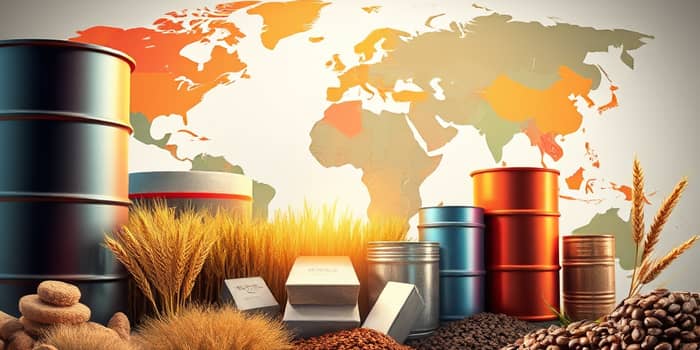
As we look toward 2026, global raw material markets stand at a critical juncture. A sustained downturn, now in its fourth consecutive year of decline, is reshaping the contours of commodities across energy, metals, and agriculture. Traders, producers, and policymakers must navigate this evolving landscape with precision and foresight to unlock potential opportunities amidst uncertainty.
Macro Context and Global Drivers
Global economic growth is projected to ease to 2.6% in 2026 from 2.7% in 2025, creating headwinds for investment-heavy sectors such as construction and manufacturing. Weak global economic growth is tempering demand for raw materials even as monetary policy adjustments and rate cuts by major central banks support financial markets.
Geopolitical tensions continue to add complexity. US tariffs on aluminum and copper remain at 50%, while China’s restrictions on rare earths cover 85% of global refining capacity. Evolving trade talks between the US, China, and Canada, alongside tensions in the Middle East, inject risk premiums into oil and precious metals.
Policy uncertainty over energy transition incentives and AI infrastructure spending further complicates forecasts. Europe’s carbon price hovering near €87 per ton and China’s push for renewable fuels underline long-term structural shifts even as near-term supply and demand remain in flux.
Energy Commodities Outlook
The energy complex faces bearish pressure overall as production outpaces consumption across key markets. Oil markets are expected to soften mid-year 2026 due to ramped-up output from non-OPEC producers and easing OPEC+ cuts. Short-term volatility may arise from geopolitical flare-ups, but the prevailing trend points lower.
Despite broad downward pressure, natural gas remains a relative winner as global LNG capacity expands by nearly 29 million metric tons and European winter demand stays firm. Oil, by contrast, faces a 19% year-on-year decline in benchmark prices as inventories build.
Metals Market Dynamics
The metals sector exhibits a split trajectory. Copper and aluminum show bullish tendencies, supported by supply deficits, US tariffs, and ramped-up AI and infrastructure investments. Other industrial metals, such as iron ore and lithium, face downward pressure from expanding Chinese output.
Copper is forecast to average around $12,125 per ton, with potential peaks near $13,000 in Q2, driven by production disruptions and arbitrage flows. Aluminum, despite a 50% tariff regime, may hold above pre-tariff levels before a gradual decline to roughly $2,350 per ton by year end.
Meanwhile, iron ore prices could slip 15% to around $88 per ton, and lithium may fall by roughly 25% to $9,100 per ton. Precious metals stand out as safe havens, buoyed by currency weakness and geopolitical risk.
Agricultural and Soft Commodities
Agricultural markets are stabilizing after recent volatility, with overall agri-food prices expected to slip just 2%. Supply largely meets demand, keeping edible oils, grains, and raw cotton prices broadly flat.
Beverages like coffee and cocoa may drop around 7% as supply surpluses persist. Fertilizer costs are set to decline roughly 5%, aided by China’s export easing on nitrogen and phosphate supplies. Yet upside risks linger from extreme weather events and potential shifts in US trade policy affecting soybeans and corn.
Risks and Wildcards
Several unpredictable factors could upend consensus forecasts. A sudden ceasefire or escalation in the Russia-Ukraine conflict would swing metals and energy prices sharply. Unexpected shifts in OPEC production quotas or strategic oil reserve releases could drive wild swings in crude benchmarks.
Other variables include weather extremes, changes in US-China trade relations, and evolving energy transition policies. Investors must remain vigilant and adaptable, ready to adjust positions as new information emerges.
- Supply disruptions and trade barriers
- Geopolitical events in oil-producing regions
- Extreme weather affecting agricultural yields
- Policy shifts in renewable energy incentives
Strategic Insights for Investors
In a landscape marked by uneven performances across sectors, a differentiated approach to commodity exposure is essential. Mixed market performance in sectors highlights the importance of tactical allocation between energy, metals, and agriculture.
Investors seeking growth may favor agricultural and natural gas positions, while risk-off portfolios could lean into precious metals as a hedge. For those with higher risk tolerance, copper and aluminum offer attractive structural upside tied to infrastructure and AI investments.
Geographic diversification can also mitigate regional headwinds. Exposure to Asian markets may capture demand growth in India and Southeast Asia, offsetting slower Chinese consumption. European commodity-linked equities could benefit from near-term carbon price stability.
Conclusion: Charting the Path Forward
As 2026 unfolds, the commodity terrain will remain dynamic and unpredictable. Market participants who combine rigorous analysis, flexible strategies, and an eye for emerging political or environmental shifts will be best positioned to uncover value.
By understanding the stabilizing agricultural markets and energy transition investments and balancing exposure across sectors, investors and industry leaders can navigate challenges and capitalize on opportunities in this pivotal year.
References
- https://www.worldbank.org/en/research/commodity-markets
- https://flow.db.com/Topics/trade-finance/commodities-outlook-2026-where-next
- https://www.oxfordeconomics.com/resource/commodities-outlook-2026-another-challenging-year-ahead/
- https://www.spglobal.com/market-intelligence/en/news-insights/research/2026/02/commodity-price-watch-february-2026
- https://home.cib.natixis.com/articles/commodities-markets-exploring-key-themes-for-2026
- https://blogs.worldbank.org/en/developmenttalk/global-agricultural-markets-in-2026--stabilizing-prices--persist
- https://think.ing.com/bundles/commodities-outlook-2026-energy-cools-as-metals-heat-up/
- https://about.bnef.com/insights/commodities/commodities-in-2026-10-numbers-to-watch-from-power-to-oil/
- https://www.morganstanley.com/im/de-de/intermediary-investor/insights/outlooks/trends-driving-optimism-in-2026.html
- https://www.morganstanley.com/im/en-au/institutional-investor/insights/articles/trends-driving-optimism-in-2026.html
- https://www.parametricportfolio.com/blog/commodity-market-outlook-2026
- https://www.spglobal.com/market-intelligence/en/news-insights/research/2026/01/commodity-price-watch-january-2026
- https://www.uscfinvestments.com/blog/uscfinvestments-mu-20260120