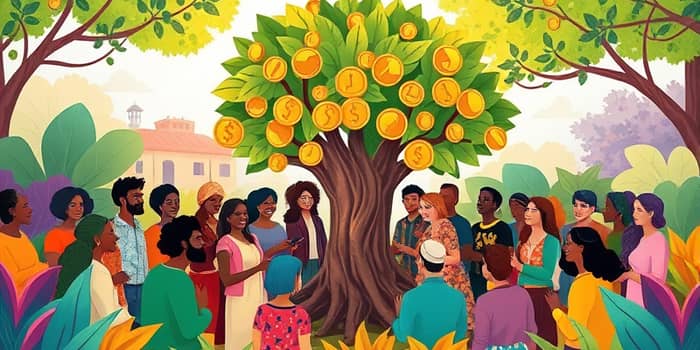
Economic empowerment is the transformative force that reshapes lives from the ground up.
It goes beyond mere financial gain to encompass the ability to provide for oneself and dependents with dignity.
This process enables access to social and economic opportunities that foster personal and community growth.
At its core, it builds resilience and autonomy through informed choices and financial independence.
By breaking cycles of poverty, it creates a domino effect of positive change.
Financial stability and literacy are essential foundations for this journey.
Together, they empower individuals to navigate challenges and seize opportunities.
The Flaws in Traditional Economic Models
Traditional approaches often focus narrowly on individual wealth accumulation.
They ignore critical factors like power dynamics, race, and culture.
This can lead to harmful narratives that marginalize communities.
Such models prioritize behavior change over systemic justice.
As a result, they fail to address the root causes of economic inequity.
Empowerment requires a shift from exploitation to independence.
It must center on community strengths rather than deficits.
Empowerment Economics: A Community-Led Alternative
Empowerment Economics offers a holistic framework developed by affected communities.
It emerged from partnerships like the Institute on Assets and Social Policy.
This approach is rooted in racial and economic justice principles.
It leverages local cultures and values for sustainable development.
The framework includes six core elements that guide its implementation.
- Community-driven: Developed by those directly impacted.
- Culturally connected: Draws on cultural roots for strength.
- Narrative-changing: Uplifts community capabilities and values.
- Holistic: Addresses multiple aspects like housing and finance.
- Multigenerational: Engages all ages for knowledge sharing.
- Wealth- and power-building: Focuses on redistribution and autonomy.
These elements ensure that empowerment is inclusive and transformative.
Scholarly roots blend Critical Race Theory with participatory action research.
This creates accountable knowledge that challenges systemic inequities.
Key Components for Sustainable Empowerment
Building blocks from frameworks like Desjardins provide practical steps.
They focus on international development but apply broadly to communities.
- Access to financial services: Secure banking and credit options.
- Financial literacy and knowledge: Skills for confident decision-making.
- Power to act: Independent control over economic choices.
Supports include addressing financial trauma and ensuring living wages.
Safe work environments and budgeting tools are also crucial.
Education, job training, and grants further enhance opportunities.
Cultural considerations emphasize interdependence over individualism.
This aligns with community-oriented values for collective well-being.
Professional development and asset independence drive long-term success.
Real-World Success Stories
Case studies demonstrate the effectiveness of community-led models.
These examples show how empowerment can be tailored to local needs.
- Foundations for the Future: A Native Hawaiian program with cultural relevance.
- Root to Fruit: Korean-led youth programs in Chicago.
- MassUP Winchendon Evaluation: Addresses racial inequities in Massachusetts.
- NAYA initiatives: Native American projects in Portland, Oregon.
- Post-trafficking support: Reduces vulnerability through crisis management.
Each project highlights the importance of holistic and inclusive approaches.
They prove that empowerment starts from within communities.
Networks are expanding to include more place-based organizations.
The Ripple Effect: Benefits and Broader Impact
Empowerment Economics fosters systemic change beyond individual gains.
It shifts grantmaking toward equitable funding and measurement practices.
This supports community organizations in building sustainable wealth.
Benefits include increased economic mobility and reduced vulnerability.
- Enhanced financial stability and autonomy for families.
- Stronger social capital and supportive interdependence.
- Greater participation in local economic activities.
- Improved resilience against systemic marginalization.
- Long-term advancement in community well-being.
The impact extends to countries, promoting overall economic growth.
It challenges harmful narratives and uplifts community strengths.
This creates a foundation for lasting social and economic justice.
This comparison highlights the transformative potential of community-centric models.
A Call to Action: Investing in Community Strength
Everyone can contribute to fostering economic empowerment in their circles.
Start by supporting local organizations that prioritize community-led initiatives.
Advocate for policies that ensure access to financial services for all.
Promote financial literacy programs tailored to cultural contexts.
Engage in multigenerational dialogue to share knowledge and resources.
- For communities: Develop grassroots networks and leverage cultural strengths.
- For funders: Shift toward equitable practices and measure impact holistically.
- For policymakers: Implement supports like living wages and safe work standards.
- For individuals: Build skills through education and mentorship opportunities.
- For organizations: Foster partnerships that amplify marginalized voices.
Investing in community strength requires a commitment to long-term change.
Embrace the principles of Empowerment Economics to drive meaningful progress.
Together, we can build a future where economic well-being is shared by all.
References
- https://heller.brandeis.edu/iere/projects/empowerment-economics.html
- https://www.desjardins.com/en/news/economic-empowerment-key-condition-development.html
- https://fiveable.me/key-terms/hs-global-studies/economic-empowerment
- https://www.igi-global.com/dictionary/economic-empowerment/62179
- https://lifestyle.sustainability-directory.com/area/economic-empowerment-local-communities/