In today's unpredictable world, the concept of resilience has never been more critical.
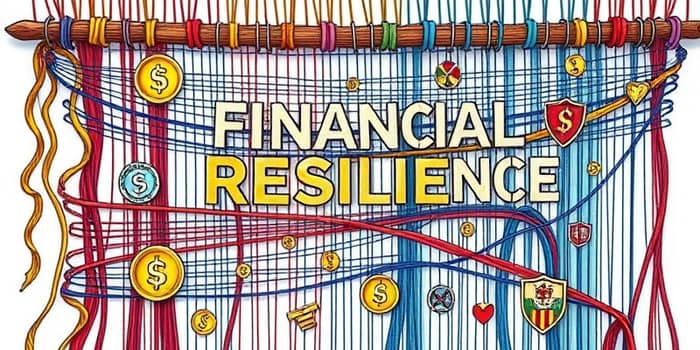
Weaving a resilient economic tapestry is about creating a durable and adaptive structure from the threads of finance.
This metaphor inspires us to build systems that can withstand shocks and thrive amid change.
From personal savings to global economies, resilience is the foundation for stability and growth.
Understanding this fabric requires exploring its various layers and interconnections.
Understanding Financial and Economic Resilience
Financial resilience refers to the ability to endure economic disruptions and recover quickly.
It involves both static elements like savings and dynamic processes such as planning.
For individuals, this means having emergency funds for unexpected crises to provide security.
Diversified income streams reduce dependency and enhance stability.
- Savings and reserves for job loss or medical emergencies
- Diversified income sources through multiple streams
- Insurance coverage for various life risks
- Proactive financial planning and adaptive behaviors
Organizations build resilience by maintaining cash reserves and adapting business models.
They must navigate systemic risks like climate change and regulatory shifts.
Economic resilience, on a broader scale, focuses on systems that absorb shocks.
It emphasizes diversity, local institutions, and innovation for long-term health.
- Ability to adapt to short-term and long-term changes
- Self-organization and learning from disruptions
- Importance of local economies and financial diversity
- Integration with ecological and social systems
This interconnectedness forms the resilient tapestry we aim to weave together.
The 2026 Global Economic Outlook: A Test of Resilience
The global economy is projected to show resilience in 2026 despite ongoing uncertainties.
Growth is expected to moderate but remain supported by key factors like consumption and investment.
According to forecasts, global GDP growth will hover around 3%, with disparities across regions.
- Global growth: 3-3.2%, stabilizing by 2027
- Key drivers: Resilient consumption, investment, and AI productivity boosts
- Risks: Trade tensions, fiscal constraints, commodity volatility
In the United States, real GDP is forecasted at 2.1% in the baseline scenario.
Consumer spending and business investment are primary supports for this outlook.
China aims for 4.5% growth through fiscal expansion and a pivot to infrastructure.
India demonstrates strong resilience with an 8% start in the first half of FY25-26.
The Eurozone expects moderate expansion, while Colombia recovers with nearshoring boosts.
Global economic disparities highlight the need for tailored resilience strategies.
Key Drivers of Resilience in the Modern Economy
Several positive factors contribute to building and maintaining resilience across levels.
Wage recovery and private investment are essential for economic stability.
- Wage recovery improving household financial health
- Private investment fueling growth and innovation
- Sectoral diversification in agriculture and tourism
- AI investment enhancing productivity and efficiency
- Nearshoring creating new economic opportunities
- Robust labor markets supporting consumer spending
The financial system plays a central role in fostering resilience.
Diversity and adaptability in finance are crucial for absorbing shocks.
Sustainability links show that climate adaptation can unlock new opportunities.
Equity for marginalized communities strengthens the overall economic fabric.
Risks and Challenges to Building Resilience
Despite positive trends, numerous risks threaten economic resilience.
Geopolitical tensions and trade issues pose significant challenges.
- Geopolitical and trade risks, such as tariffs and USMCA review
- Fiscal constraints limiting government response capabilities
- Overcapacity in industries like steel and cement
- Property downturns affecting asset values and stability
- Labor costs and external demand shortfalls
- Systemic financial imbalances and asset inflation
Shocks from commodity volatility or regulatory shifts can disrupt systems.
Interdependencies blocking innovation pose a hidden but critical challenge.
Addressing these risks requires proactive strategies and flexible thinking.
Strategies for Weaving Your Resilient Economic Tapestry
Building resilience is a multi-level endeavor that starts with individual actions.
It extends to organizations and entire economic systems for comprehensive strength.
For individuals and communities, the foundation is savings and diversification.
Emergency funds and diversified income provide a crucial safety net.
- Build and maintain substantial savings and emergency reserves
- Diversify income streams through side hustles or investments
- Secure comprehensive insurance coverage for various risks
- Engage in proactive financial planning and budgeting
- For organizations: Manage cash flow and maintain lines of credit
- Diversify portfolios and revenue sources to reduce vulnerability
- Integrate sustainability into core operations for competitive advantage
- Develop strategies for climate and resource risks
- For economic systems: Promote local financial institutions like credit unions
- Encourage mutual exchanges and peer-to-peer lending
- Support diverse and local economies for greater stability
- Foster innovation and learning within communities
Policy and macro-level strategies include fiscal stimulus and inclusive governance.
Questioning assumptions flexibly allows for better adaptation to changing conditions.
Examples of transformation, such as shifting from manufacturing to finance, show resilience in action.
Enhanced stability and sustainable development are the ultimate outcomes.
Conclusion: The Fabric of Our Future
Weaving a resilient economic tapestry is not just a metaphor but a practical necessity.
By understanding the threads of resilience, we can create a stronger and more secure future.
Embrace the strategies outlined to build your own financial fabric step by step.
Together, we can withstand shocks and thrive in an ever-changing world.
Start today by assessing your savings, diversifying your income, and planning for uncertainties.
The journey to resilience is ongoing, but each action strengthens the tapestry we all share.
References
- https://climate.sustainability-directory.com/term/financial-resilience/
- https://www.deloitte.com/us/en/insights/topics/economy/global-economic-outlook-2026.html
- https://www.caixabankresearch.com/en/economics-markets/activity-growth/world-economy-2026-resilience-transition-or-disruption
- https://digitalcommons.uri.edu/cgi/viewcontent.cgi?article=1282&context=hdf_facpubs
- https://www.morganstanley.com/insights/articles/global-economic-outlook-2026
- https://www.spglobal.com/market-intelligence/en/news-insights/research/2025/12/top-10-economic-insights-2026
- https://www.eda.gov/resources/comprehensive-economic-development-strategy/content/economic-resilience
- https://www.stlouisfed.org/on-the-economy/2025/dec/professional-forecasters-past-performance-outlook-2026
- https://pmc.ncbi.nlm.nih.gov/articles/PMC9982767/
- https://www.jpmorgan.com/insights/global-research/outlook/market-outlook
- https://economics.bmo.com/publications/detail/8c8a7423-6b43-4bf7-9b2d-09a1939daad5/
- https://www.alliancebernstein.com/americas/en/financial-professional/insights/investment-insights/the-2026-global-economy-likely-resilient-despite-frictions.html