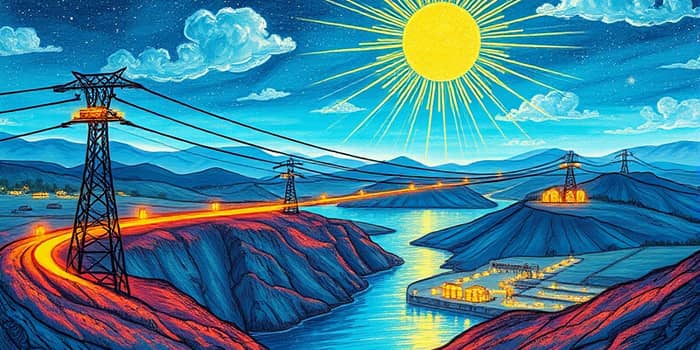
In an era defined by interconnected economies, transnational electricity networks have emerged as critical arenas of influence. By fostering integration or rivalry across borders, these grids shape market dynamics, security considerations, and sustainable development pathways.
Understanding Transnational Electricity Networks
Electricity transmission grids that span national boundaries form the backbone of modern regional cooperation. Their interconnected nature of energy flows underpins not only power exchanges but also political and economic leverage between states.
Unlike pipelines or sea routes, cross-border interconnectors can carry shocks across regions in seconds. A technical glitch in one area may trigger blackouts far beyond its origin, demonstrating how vulnerable societies become vulnerabilities that can cascade across borders.
Centre-Periphery Dynamics and Competition
Major hubs—such as the European Union, Russia, and China—feature dense, homogeneous networks that harvest economies of scale and low external permeability. In contrast, peripheral zones like the Black Sea or Central Asia host weaker grids, becoming contested bridges between powerful centres.
As new interconnectors proliferate, traditional peripheries transform into arenas of techno-political rivalry. Emerging players compete to export equipment, impose technical standards, or offer financing, intensifying the struggle for influence.
- European Union: Customs of regulatory harmonization and collective investments
- China’s Belt and Road Initiative: Exporting grid hardware and norms
- Russia: Leveraging legacy Soviet infrastructure in Eastern Europe and Asia
- Other actors: India, Turkey, and Iran forging new energy links
Comparing Energy Corridors: Grids, Pipelines, and Sea Routes
Traditional energy corridors—pipelines and maritime routes—serve as static arteries, whereas electricity grids form dynamic networks. Understanding their distinctions is key to navigating a multipolar energy competition landscape.
While pipelines lock partners into fixed trajectories, shared grids invite both collaboration and risk. A diplomatic spat can translate into power cuts and market turbulences, underlining the need for robust governance structures.
Risks, Resilience, and Market Implications
Electricity grids’ complexity raises stakes: a single failure can ripple through continents, triggering price spikes and supply crises. Stakeholders must prioritize building diverse and resilient energy networks to mitigate systemic shocks.
Investors and policymakers increasingly account for geopolitical risks when financing projects. By leveraging regional cooperation and aligning norms, they can secure stable returns while advancing climate goals and respecting planetary boundaries.
- Conduct vulnerability assessments for critical transmission links
- Invest in smart grid technologies and cybersecurity measures
- Foster multilateral agreements to guarantee uninterrupted flows
Future Horizons: Digital and Hydrogen Corridors
The next frontier lies in digital smart grids and hydrogen pipelines. Digitalization promises real-time balancing and demand response, while hydrogen routes can decarbonize hard-to-electrify sectors.
As states pilot cross-border hydrogen projects, grids evolve into technology-enabled platforms for sustainable growth, reshaping the geopolitical terrain and opening fresh opportunities for collaboration.
Charting a Path Forward: Practical Steps
To harness the promise of geopolitical grids, stakeholders must adopt a holistic mindset. By integrating technical expertise with diplomatic savvy, they can turn potential flashpoints into catalysts for cooperation.
Business leaders, regulators, and civil society alike play roles in steering grids toward equitable, secure, and green outcomes. Embracing innovation, sharing best practices, and nurturing trust will be essential for success.
- Promote cross-sector collaboration at the regional level
- Support research in low-carbon and digital energy solutions
- Engage local communities to build social license and resilience
References
- https://www.swp-berlin.org/10.18449/2022RP06/
- https://energy.sustainability-directory.com/term/geopolitical-energy-corridors/
- https://chass.usu.edu/international-studies/aggies-go/geopolitics-defined
- https://lifestyle.sustainability-directory.com/term/geopolitical-dimension/
- https://geopoliticalfutures.com/risk/
- https://ideas.repec.org/p/zbw/swprps/62022.html
- https://en.wikipedia.org/wiki/Geopolitics