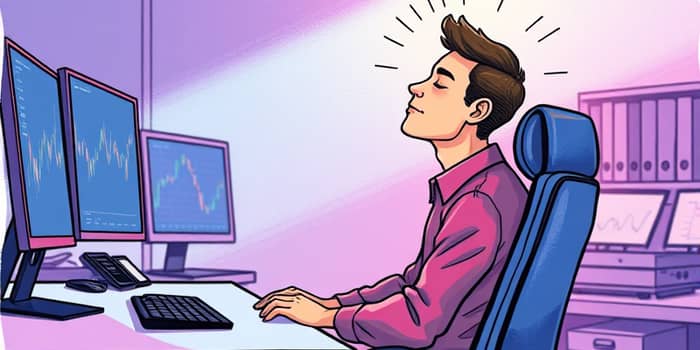
Trading success hinges not only on charts or systems, but on the trader’s inner landscape. By focusing on mindset first, you can achieve emotional control via awareness and reshape your performance.
Why Psychology Matters More Than Strategy
Studies show that 85% of market performance is driven by the state of mind rather than any technical indicator. Without stability in your emotions, even the best analytics and risk rules can fail.
Alexander Elder’s three pillars of trading place psychology at the apex, followed by analysis and money management. When the mind is off balance, both analysis and capital rules collapse under stress.
The Emotional Roller Coaster Explained
Trading triggers a spectrum of emotions that can undermine discipline. From the euphoria of a winning streak to the despair of a deep loss, these swings challenge consistency.
- Fear: Causes hesitation, missed opportunities, and panic exits.
- Greed/FOMO: Tempts overleveraging and chasing rallies.
- Overconfidence: Fuels oversized positions after a few wins.
- Revenge trading: Attempts to recoup losses quickly lead to bigger defeats.
Recognizing these triggers is the first step to neutralizing their impact on your decision-making.
Common Cognitive Biases and Traps
Under pressure, the brain leans on mental shortcuts that can mislead. Identifying these biases helps you design countermeasures to protect your capital.
By logging each impulsive move, you can spot patterns and introduce rules to interrupt these cycles.
Three Pillars Framework
The path to reliable performance rests on three interlocking domains:
- Mind: Cultivate awareness and detachment.
- Analysis: Develop a clear method for reading price action.
- Money Management: Enforce risk limits and position sizing.
Each pillar must support the others. A strong plan without the right mindset will crumble under stress.
Tools and Techniques for Mastery
To build mental resilience and refine your edge, integrate proven methods into your routine:
- Structured trading plan with predefined entries, exits, and maximum risk per trade.
- Performance data analysis tracking hit rates, average wins, and drawdowns to identify strengths.
- Journaling metrics to capture emotional states, impulsive trades, and lessons learned.
- Backtesting to validate hypotheses and replace fear with statistical confidence.
- Mindset techniques like breath control or brief meditation to restore calm after a loss.
Combining these tools fosters self-trust and creates a feedback loop of continuous improvement.
Path to Consistency
Consistency emerges through repetition and incremental progress. Rather than chasing perfection, aim to refine one aspect of your approach at a time.
Stage 1: Build self-trust by executing your plan without deviation. Each compliant trade strengthens confidence.
Stage 2: Enter a flow state through structured routines. When your plan becomes second nature, your mind frees up to react fluidly.
Stage 3: Adopt the observer mindset—stepping back to watch your emotions without judgment, allowing you to act from clear reasoning rather than impulse.
Advanced Brain Science Insights
Research highlights the role of the dorsomedial prefrontal cortex in processing social signals like order flow clusters. This theory of mind mechanism can bias you toward herding behavior or bubble chasing.
Volatility clustering and non-Gaussian returns in asset prices often reflect collective psychological tension. By understanding these patterns, you can anticipate when the crowd’s mood may shift and adjust risk exposure accordingly.
Putting It All Together
Mastering market psychology is an ongoing journey, not a destination. Regularly review your performance data, journal every key trade, and adjust rules to shore up emerging weaknesses.
Embrace the fact that losses are part of the process. By learning to welcome feedback, you transform setbacks into powerful growth experiences.
Conclusion
Your greatest trading asset is your mind. By prioritizing emotional control via awareness and leveraging structured routines, you can achieve sustained success in the markets.
Commit to the mental work, refine your edge through data, and cultivate the observer within. This combination will give you the psychological edge required to navigate markets with confidence and consistency.
References
- https://liquidityfinder.com/news/trading-psychology-is-the-key-master-your-mind-in-the-markets-1ffac
- https://tradewiththepros.com/emotional-control-in-trading/
- https://pmc.ncbi.nlm.nih.gov/articles/PMC3781325/
- https://www.elearnmarkets.com/school/units/trading-psychology
- https://www.lseg.com/en/solutions/hedge-funds/podcast/hedge-fund-huddle/season-3-episode-3-psychology-trading-performance-data-how-use-your-advantage
- https://www.nadex.com/blog/understanding-the-importance-of-trading-psychology/
- https://www.youtube.com/watch?v=LPQKv3YD-H4
- https://acy.com/en/market-news/education/trading-psychology-controlling-yourself-j-o-20251201-083810/
- https://lsegissuerservices.com/spark-insights/s4H5HBaR4mdtLPN7DFiGGo/hedge-fund-huddle-episode-3-season-3-the-psychology-of-trading-performance-data-and-how-to-use-it-to-your-advantage
- https://www.ig.com/en/trading-strategies/the-importance-of-psychology-in-trading-190315
- https://edgewonk.com/blog/the-ultimate-guide-to-the-10-most-important-trading-metrics
- https://www.dukascopy.com/swiss/english/marketwatch/articles/trading-psychology/
- https://tradethatswing.com/the-day-trading-success-rate-the-real-answer-and-statistics/
- https://lightspeed.com/active-trading-blog/a-complete-guide-to-trading-psychology