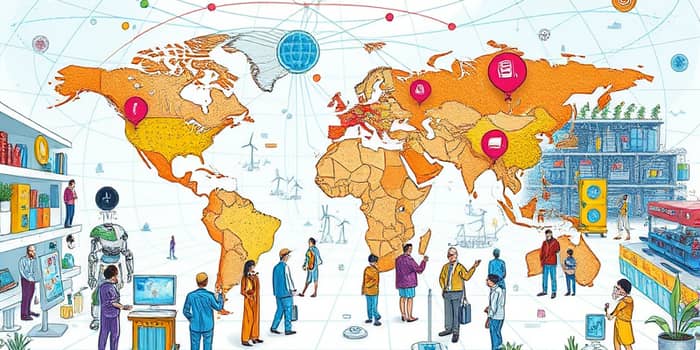
In an era of unprecedented change, businesses and policymakers must adapt rapidly to seize emerging opportunities. This comprehensive guide offers a roadmap for successfully navigating complex global landscapes.
From technological breakthroughs to shifting geopolitical alliances, the world economy is evolving at breakneck speed. Leaders who embrace innovation and strategic thinking can unlock new markets and drive sustained growth.
Technology and Innovation Trends
Artificial intelligence has emerged as a foundational amplifier of other trends, revolutionizing industries from robotics training to bioengineering. As AI systems mature, they are combining with semiconductors and autonomous platforms to deliver unprecedented levels of performance.
Agentic AI and application-specific chips are no longer futuristic concepts—they are powering practical applications in everyday settings, from smart factories to personalized healthcare. Cloud providers and startups alike are scaling infrastructure to meet the exponentially higher demands for computing required by advanced models.
Market consolidation has intensified as leading technology giants form strategic alliances, controlling vast portions of the generative AI ecosystem. This dynamic raises important questions about competition, innovation, and access in the years ahead.
Global Economic Growth and Outlook
Global GDP growth is projected to slow gradually, dipping from 3.3% in 2024 to an average of 2.5% by 2027. Advanced economies are expected to maintain growth around 1.5%, while emerging markets and developing regions hover just above 4%.
Trade volumes face headwinds as policy uncertainty and geopolitics weigh on cross-border flows. Yet, rising prices have inflated overall trade value, highlighting resilience in global exchange despite volume constraints.
Regional performance is diverging: while developed markets outpaced the Global South in early 2025, emerging Asian economies are poised to benefit from a softer dollar and strategic investments in semiconductor fabrication.
Sectoral Opportunities and Growth Areas
As technologies advance, certain sectors stand out for their ability to capture value and drive returns. Investors and executives should consider the following high-potential areas:
- Semiconductor and infrastructure: Accelerated by AI-driven demand, these industries offer robust earnings growth.
- Renewable energy and utilities: Grid modernization and data center expansion underpin strong investment cases.
- Defense and reshoring initiatives: Boosted by higher government spending in developed regions.
- Consumer discretionary: Supported by resilient household demand and targeted fiscal stimulus.
Financial services also stand to gain from a steeper yield curve, regulatory easing, and increased merger-and-acquisition activity, with more than $200 billion in corporate tax savings bolstering balance sheets.
Labor Market and Employment Transformation
Structural shifts in the labor market are expected to generate 170 million new jobs by 2030, while displacing 92 million positions. The net effect—78 million additional roles—reflects a 7% increase in global employment.
Employers are prioritizing skills such as creative thinking, resilience, agility, and advanced information processing. As robotics and automation become more pervasive, workers who embrace lifelong learning and adaptability will thrive.
Energy transition roles in generation, storage, and distribution are also gaining prominence, signaling a robust future demand for green technology expertise.
Geopolitical and Policy Context
Technological supremacy has become a central theater of international competition. Nations are investing heavily in sovereign infrastructure, localized chip fabrication, and research funding to reduce supply-chain vulnerabilities and enhance security.
Policy uncertainty has reached a multi-decade high, with rising tariffs and shifting trade agreements creating an unpredictable business environment. While some tensions have eased through targeted deals, prolonged volatility could dampen investment and growth.
Marketing and Consumer Trends
Brands that deliver personalized, omnichannel experiences are outpacing competitors in customer engagement and revenue growth. First-party data strategies are becoming indispensable in an era of heightened privacy concerns.
- GenAI-powered campaigns: Automation and AI tools are driving efficiency and relevance.
- Omnichannel integration: Seamless experiences across online, mobile, and in-store channels.
- Personalized content delivery: Leading to higher conversion rates and loyalty.
Marketers who invest in these areas will position their organizations to exceed targets and foster deeper consumer trust.
Global System Transformation
The post–World War II international order is giving way to a multipolar landscape. Wealth and influence are shifting eastward as emerging powers solidify their economic footholds.
By mid-century, BRIC nations may rival the original G-7 in combined GDP share, reshaping trade patterns and political alliances. Nonstate actors, from multinational corporations to non-governmental organizations, are increasingly driving global agendas.
Risk Factors and Challenges
Despite opportunities, businesses must navigate a range of risks that could derail growth:
- Fiscal vulnerabilities and debt pressures in key economies.
- Market corrections and financial instability triggered by policy shifts.
- Prolonged geopolitical tensions affecting trade and investment flows.
Companies should conduct robust scenario planning, stress-test their supply chains, and maintain prudent balance-sheet management to mitigate these threats.
Innovation and Business Transformation
Responsible innovation is emerging as a critical differentiator. As AI and biotech tools grow more powerful, trust becomes the gatekeeper for adoption. Organizations must develop frameworks for ethical deployment and stakeholder engagement.
Climate-related imperatives are also reshaping business models. In the next five years, one-third of companies expect green-transition initiatives to fundamentally alter their operations, driving investments in sustainable supply chains and carbon-efficient processes.
By embracing these trends—technology integration, human-centric skills development, and responsible governance—leaders can confidently navigate new markets and build resilient, future-ready enterprises.
References
- https://www.mckinsey.com/capabilities/tech-and-ai/our-insights/the-top-trends-in-tech
- https://www.bny.com/corporate/global/en/insights/gears-in-motion-global-market-outlook-2025.html
- https://unctad.org/publication/global-trade-update-july-2025-global-trade-endures-policy-changes-and-geoeconomic-risks
- https://www.imf.org/en/publications/weo/issues/2025/10/14/world-economic-outlook-october-2025
- https://www.weforum.org/publications/the-future-of-jobs-report-2025/digest/
- https://www.deloittedigital.com/nl/en/insights/perspective/marketing-trends-2025.html
- https://www.edc.ca/en/article/global-economic-trends.html