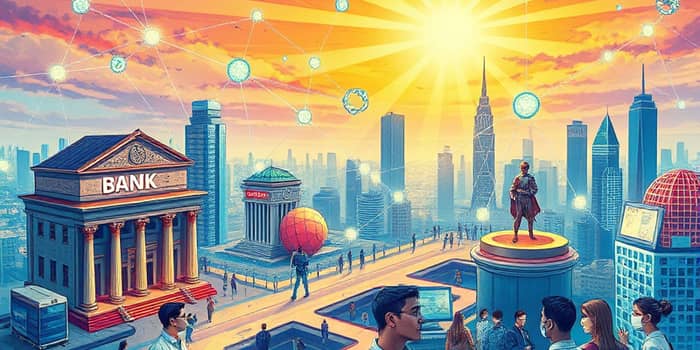
In an era defined by rapid technological advances and ever-shifting markets, the concept of a unified financial ecosystem has risen from academic theory to practical reality. Spanning traditional banks, nimble fintech startups, investors, regulators, and consumers, this ecosystem thrives on collaboration and synergy among participants. As we delve into its layers, we explore how these actors co-create value, confront challenges, and shape the future of finance.
By understanding the forces that bind this network together, professionals and consumers alike can harness opportunities for innovation, resilience, and inclusive growth. This article maps the ecosystem’s core elements, growth trends, technological drivers, and strategic shifts, offering actionable insights for stakeholders at every level.
Understanding the Complex Fabric of Finance
The financial ecosystem can be envisioned as a complex, interconnected network of institutions, markets, instruments, and regulations facilitating the flow of capital. It functions not as a static hierarchy, but as a dynamic, adaptive system. Academic research highlights its embedding in socio-ecological contexts, where capital allocation decisions influence human welfare and environmental outcomes in equal measure.
What distinguishes this ecosystem is its emergent behavior: institutions and technologies co-evolve, responding to regulatory constraints, market demands, and macroeconomic forces. As roles shift—banks partner with tech firms, regulators adapt to novel business models, and consumers demand seamless digital experiences—the ecosystem demonstrates its remarkable ability to reconfigure.
Key Components and Actors
At the heart of this network are distinct yet interdependent participants. Each actor contributes specialized functions while drawing strength from collective innovation.
- Fintech Startups: Agile innovators solving niche pain points with data-driven solutions.
- Established Financial Institutions: Banks, insurers, and asset managers integrating new technologies.
- Technology Providers: Cloud, blockchain, and AI platform vendors powering core infrastructure.
- Investors: Venture capital, private equity, and institutional backers fueling growth.
- Regulators: Guardians of market stability, shaping compliance through evolving rules.
- Consumers: End users whose demands for convenience and security drive innovation.
Behavioral Traits and Adaptation
Participants in this ecosystem exhibit three defining behavioral characteristics that enable flexibility in a volatile environment.
- Duality: Performing opposing roles simultaneously, such as long-term investing and short-term funding.
- Hybridity: Blending intermediation, risk transfer, and infrastructure functions seamlessly.
- Fluidity: Shifting strategies and offerings in response to incentive structures and regulatory changes.
These traits underscore the ecosystem’s resilience. When disruptions occur—whether a sudden rate hike or a compliance overhaul—entities can pivot, repurpose assets, and forge new alliances to sustain growth.
Current Market Dynamics and Growth Trends
The fintech sector’s rapid expansion underscores the ecosystem’s vitality. In 2024, the global market reached $340.10 billion and is projected to exceed $1.1 trillion by 2032, a trajectory driven by both rising demand and technological breakthroughs.
Investment activity, while still robust, has become more discerning. Total fintech funding stood at $95.6 billion across 4,639 deals in 2024, dropping to $44.7 billion in H1 2025—which signals a shift from quantity to quality in deal-making.
Profitability has accelerated: in 2024, 69% of publicly listed fintechs reported profits, up from under half the previous year. The payments sector alone generated $2.4 trillion in revenue and is set to exceed $3 trillion by the end of the decade.
Technological Innovation Drivers
Innovation lies at the ecosystem’s core. Artificial intelligence, cloud computing, blockchain, real-time payments, and open banking are rewriting the rules of product development and service delivery. AI in fintech—valued at $30 billion in 2025—is projected to grow almost threefold by 2030, making it a crucial differentiator.
Generative AI models are streamlining compliance, personalizing customer experiences, and enabling risk analytics at unprecedented scale. Meanwhile, blockchain is enhancing transaction transparency and security, and real-time payment platforms are redefining customer expectations for speed and reliability.
Industry Trends and Strategic Shifts
The traditional paradigm of competition is giving way to "co-opetition," where strategic partnerships drive innovation faster than isolated efforts. Banks form alliances with fintech startups to launch new products, technology companies embed financial services into non-financial apps, and regulators engage in sandbox experiments to balance safety with innovation.
Financial inclusion has moved beyond corporate social responsibility to become a growth engine. Alternative credit models based on mobile data are unlocking services for underserved populations, while governments and NGOs collaborate with private sector innovators to boost financial literacy and digital access.
Challenges and Future Outlook
Despite its promise, the ecosystem faces headwinds. Traditional banks risk losing market share as digital challengers offer more transparent fees and faster onboarding. Pricing pressures in card-based payments, increasing compliance costs, and macroeconomic uncertainties demand continuous adaptation.
Environmental, social, and governance (ESG) imperatives are reshaping investment and lending criteria. Institutions must balance profit motives with sustainability goals, integrating green finance solutions and ethical frameworks into their core operations.
Foundational Drivers of Ecosystem Evolution
The ecosystem’s trajectory is guided by six persistent forces that shape every strategic decision and innovation cycle.
- Regulatory rules and evolving compliance requirements.
- Interest rate regimes influencing capital allocation.
- Technological capabilities unlocking new service models.
- Competitive pressures demanding agility.
- Macroeconomic uncertainty driving resilience-building.
- ESG imperatives fostering socially conscious finance.
Understanding these drivers enables stakeholders to anticipate change, innovate responsively, and build robust, future-ready organizations that serve both financial goals and broader societal needs.
Conclusion: Harnessing Interconnected Growth
The financial ecosystem’s power lies in its interdependence. By embracing collaboration, leveraging cutting-edge technologies, and aligning with evolving regulatory and societal expectations, participants can unlock unprecedented value. Whether you represent a global bank, a fintech startup, or a regulatory body, recognizing the ecosystem’s dynamic, adaptive capacity is key to navigating complexity and driving sustainable growth.
As we move forward, the collective ambition must be to cultivate an ecosystem that is not only profitable but also inclusive, resilient, and environmentally responsible. Through shared vision and coordinated action, the interconnected web of financial actors can propel the global economy toward a more equitable and prosperous future.
References
- https://blog.brankas.com/fintech-ecosystem/
- https://www.bcg.com/publications/2025/the-future-of-finance-fit-for-growth-built-for-purpose
- https://lifestyle.sustainability-directory.com/term/financial-ecosystem/
- https://infomineo.com/industries/financial-services/finance/financial-industry-trends-in-banking-and-fintech-in-2025/
- https://jemi.edu.pl/call-for-papers-archive/603-financial-ecosystems-concepts-and-practice
- https://www.jpmorgan.com/insights/payments/fx-cross-border/2025-trends-for-financial-institutions
- https://anandautar.substack.com/p/the-financial-ecosystem-a-foundational
- https://kpmg.com/xx/en/what-we-do/industries/financial-services/pulse-of-fintech.html
- https://www.zuehlke.com/en/insights/financial-services-ecosystem-guide
- https://www.digitalsilk.com/digital-trends/fintech-trends-statistics/
- https://menttor.live/library/understanding-the-financial-ecosystem
- https://www.mckinsey.com/industries/financial-services/our-insights/global-payments-report
- https://www.ey.com/en_gl/industries/financial-services/ecosystems-financial-services/how-harnessing-the-power-of-ecosystems-can-make-finance-effortless
- https://www.weforum.org/stories/2025/08/communications-platforms-and-next-era-of-financial-inclusion/
- https://www.nefe.org/initiatives/ecosystem/default.aspx
- https://www.imf.org/en/news/articles/2025/10/29/pr-25351-imf-releases-the-2025-financial-access-survey-results
- https://fintechmagazine.com/news/behind-the-wheel-of-growth-fintech-innovations-in-2025
- https://www.deloitte.com/us/en/insights/topics/economy/us-economic-forecast/united-states-outlook-analysis.html