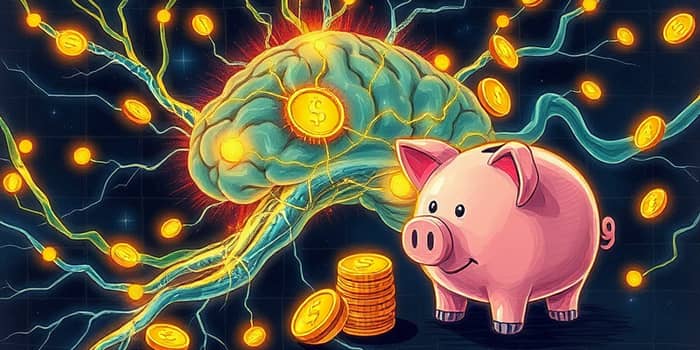
Every financial journey begins with a single choice to set aside resources for tomorrow. Yet, despite the best intentions, many find saving a persistent challenge. Recent advances in neuroscience reveal the hidden forces shaping our saving habits and offer actionable strategies to transform fleeting resolutions into enduring behavior.
Introduction to the Neuroscience of Saving
Our brains are wired to learn through repetition, gradually shifting control of behaviors from conscious decision centers to automatic routines. This process underlies why brushing teeth becomes effortless over time but why saving often remains a deliberate effort.
By understanding the neural architecture behind habit formation, we can harness strengthening neural circuits associated with behavior and guide ourselves toward better financial outcomes.
Brain Pathways: From Decisions to Automatic Habits
The corticostriatal pathway links the prefrontal cortex—our seat of conscious planning—with the dorsal striatum, where routines become ingrained. Early saving decisions demand active engagement of the dorsolateral and ventromedial prefrontal cortex.
With repetition, control shifts from the prefrontal cortex to the dorsal striatum, making deposits to savings feel more instinctive and less taxing on willpower.
The Role of Dopamine and Neural Reinforcement
Dopamine fuels the reinforcement of rewarding actions. Each time you transfer money to savings, dopamine surges, reinforcing connections between decision centers and habit circuits.
Neurons tracking both cost and reward refine their timing in a critical 400-millisecond window, ensuring the brain optimizes behavior for the best trade-off. This reward processing and habit formation cycle cements saving as an automatic choice.
Overcoming Present Bias: Psychology Meets Neuroscience
Present bias drives us to favor immediate gratification over future benefits. When given a choice, we often prefer spending now rather than safeguarding our long-term well-being.
However, enhancing future self-continuity—our emotional connection to who we will become—can counteract this bias. By vividly imagining tomorrow’s self, we close the gap between present desires and future goals, diminishing the pull of short-lived temptations.
Studies show that increased self-continuity correlates with healthier asset accumulation and stronger saving resolve.
Virtual Reality and Future Self-Continuity
Cutting-edge experiments immerse participants in encounters with age-progressed avatars of themselves. Those who confront a convincing vision of their future self allocate more than twice as much to retirement accounts—an average of 172 dollars versus 80 dollars for control groups.
This powerful intervention leverages vivid embodiments of one's future self to elicit lasting shifts in temporal discounting and spending preferences.
Practical Interventions Grounded in Brain Science
Translating neuroscience into daily habits requires evidence-based programs that align with our brain’s natural learning processes. Below are proven strategies to prime your mind for saving:
- Save More Tomorrow program: Commit in advance to channel a portion of future raises into savings, gradually increasing savings rates over time without feeling a pinch today.
- Automatic transfers and reminders: Schedule deposits to occur on payday, leveraging neuroplasticity by reducing dependence on willpower.
- Nudge architecture: Arrange choices so that the default option maximizes saving—opt-out rather than opt-in models harness our inertia for good.
Building Sustainable Saving Habits
Establishing a resilient saving routine involves small, consistent actions that reinforce each other over time. Begin by setting micro-goals and tracking progress visually to engage the reward system.
Consider these steps to embed saving into your daily life:
- Automate a modest deposit each payday to align with consistent small contributions each month, reducing decision fatigue.
- Use commitment contracts—pledges that impose mild penalties for non-compliance—to boost accountability and self-control.
- Leverage social support by sharing goals with friends or family, tapping into communal motivation and reinforcement.
Future Directions and Clinical Applications
Insights into neural signals and habit entrenchment extend beyond finances, informing treatments for disorders marked by repetitive behaviors, such as obsessive-compulsive disorder and Parkinson’s disease. Mapping cost-benefit neural representation may unlock targeted therapies that recalibrate maladaptive routines.
As research deepens, personalized interventions—tailored with neural biomarkers and virtual reality experiences—promise to revolutionize how we cultivate healthy habits and diminish burdensome ones.
By merging the rigor of neuroscience with practical habit-design principles, anyone can harness the brain’s innate plasticity to secure a more prosperous future.
References
- https://pmc.ncbi.nlm.nih.gov/articles/PMC3949005/
- https://bcs.mit.edu/news/wired-habit
- https://tutoring.hsa.net/blogs/students-published-works/lwl-the-psychology-behind-financial-choices-the-role-of-cognitive-biases-and-behavioral-economics-in-influencing-spending-and-saving-habits
- https://www.brainfacts.org/thinking-sensing-and-behaving/diet-and-lifestyle/2023/habits-101-the-neuroscience-behind-routine-121923
- https://www.morningstar.com/personal-finance/psychology-saving-habits
- https://www.youtube.com/watch?v=Wcs2PFz5q6g
- https://www.apa.org/monitor/2023/06/psychology-of-spending
- https://pmc.ncbi.nlm.nih.gov/articles/PMC6701929/
- https://www.curtin.edu.au/news/media-release/research-finds-savvy-savers-less-likely-become-impulsive-spenders/
- https://www.healthline.com/health/the-science-of-habit
- https://www.hvcu.org/learning-center/the-brain-money-connection/
- https://thesystemsthinker.com/the-neuroscience-of-new-habits/
- https://www.stmarysbank.com/learn/tools---resources/blog/detail/the-psychology-of-spending-and-how-to-manage-it
- https://www.sunnydayfund.com/blog/how-behavioral-science-enables-better-savings-habits