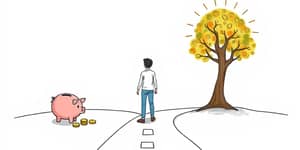
We often think of wealth as a linear progression, but in reality, it behaves more like quantum particles.
These discrete quanta of capital concentrate in ways that defy simple explanation, creating a world of extreme inequality.
Understanding this dynamic is crucial for navigating or changing the economic landscape, with profound implications from global policies to personal finance.
The data reveals that wealth has reached historic highs, yet it is hoarded by a tiny elite, driven by systemic factors that reward capital over labor.
In this article, we explore the quantum analogy, delve into statistics, and uncover practical ways to address disparities, starting with the global picture.
The Quantum Analogy: Wealth as Discrete Particles
Quantum mechanics shows particles existing in multiple states and interacting complexly; similarly, wealth can be seen as quanta—individual assets or income shares—accumulating unpredictably.
At the top, a few "particles" hold immense energy, representing the ultra-rich, while the bottom shares remain near zero, trapped in scarcity.
This extreme concentration mirrors quantum fields where particles cluster, helping us understand the randomness and structure behind economic inequality.
By framing wealth this way, we move beyond numbers to grasp the forces shaping distribution, revealing hidden dynamics in our societies.
Global Wealth Inequality: The Stark Reality
According to the World Inequality Report 2026, global wealth is at an all-time high, but distribution is more skewed than ever.
The top 0.001%, fewer than 60,000 people, own three times the wealth of the bottom 50% of humanity.
Their share rose from 4% in 1995 to over 6% in 2025, highlighting capital accumulation at the top outpacing global GDP growth.
Billionaires and multimillionaires have seen wealth grow by about 8% annually since the mid-1990s, far exceeding economic expansion.
Here is a breakdown of key wealth groups:
This table illustrates dramatic disparities, with the top 10% owning three-quarters of private wealth and the bottom half holding a mere 2%.
Such intergenerational shifts lock younger cohorts out of prosperity, emphasizing the need for change.
Drivers of Wealth Concentration
Several factors contribute to extreme inequality, and understanding them is the first step toward addressing it.
- Capital returns exceeding GDP growth: Investments in assets like stocks yield higher returns than economic expansion, benefiting capital owners.
- Policy choices: Tax systems and financial regulations often favor the wealthy, reducing redistribution.
- Unequal human capital: Access to education and skills varies widely, perpetuating income gaps.
- Asset inflation: Rising prices for homes enrich owners but exclude those without property.
These drivers create a feedback loop where the rich get richer, and the poor struggle to catch up.
It represents a structural shift from wage redistribution to capital ownership, defining modern economies.
U.S.-Specific Dynamics: The Great Asset Migration
In the United States, household wealth totals $167.26 trillion, but it is heavily concentrated by age and generation.
Federal Reserve data shows over-55s hold 73% of wealth, peaking near retirement, a shift from 1990 when working-age groups held 70%.
This "Great Asset Migration" has moved wealth to older cohorts, leaving younger generations burdened with debt and high housing costs.
Here is a generational breakdown:
- Millennials and Gen Z (born 1981+): $17.97 trillion, 10.7% of total wealth.
- Gen X (1965-1980): $43.70 trillion, 26.1%.
- Baby Boomers (1946-1964): $85.41 trillion, 51.1%.
- Silent Generation and earlier: $20.18 trillion, 12.1%.
This age-based wealth gap highlights how intergenerational transfers and market dynamics favor older Americans.
The top 20% of households earn an average of $316,100 and take 52.2% of national income, up from 43.5% in 1974.
Regional Disparities and Global Examples
Wealth inequality varies globally, with some regions exhibiting even starker contrasts.
- South Africa: The top 10% own 86% of wealth, unchanged over the past decade.
- India: The top 10% held 57% of national income in 2021, with the bottom 50% at only 13%, worsening in recent years.
- Geography of opportunity: In North America and Oceania, average monthly income per capita exceeds €3,800, while in Sub-Saharan Africa, it's around €300.
Education spending reflects these gaps, with high-income regions spending €9,000 per child annually in PPP terms, compared to €200-220 in Sub-Saharan Africa.
Such disparities entrench intergenerational hierarchies and limit mobility, creating cycles of poverty.
Intersecting Dynamics: Climate, Gender, and Finance
Wealth inequality intersects with other critical issues, amplifying their impact on society and the environment.
- Climate inequality: The top 10% cause 77% of capital-related greenhouse gas emissions and 47% of consumption emissions.
- Gender gap: Women earn 28% of global labor income, unchanged since 1990, and work 53 hours per week including unpaid labor.
- Financial system: Approximately 1% of global GDP flows yearly from poor to rich countries through debt, profits, and yields.
These climate links and gender gaps show how wealth concentration exacerbates social and environmental crises.
Addressing them requires integrated solutions that tackle root causes of inequality.
Historical Trends and the Path Forward
Since 1990, global wealth has shifted dramatically, with the top 0.001% share rising from 4% to 6.1%.
Billionaires' wealth has grown at double the rate of the bottom half's income, driven by policy choices and asset inflation.
In the U.S., the wealth curve has flattened upward, with middle-age shares declining, highlighting systemic issues.
To combat these dynamics, bold policy interventions are needed, such as a progressive wealth tax on the ultra-rich.
This could yield 1% of GDP for social and climate programs, reducing inequality and funding public goods.
Practical Steps for Individuals and Societies
While systemic change is essential, individuals can engage with and influence wealth dynamics in meaningful ways.
- Educate yourself on economic policies and advocate for fair taxation and regulation.
- Support businesses and initiatives that promote wealth redistribution and sustainability.
- Invest in diverse assets to build personal wealth, while pushing for inclusive financial systems.
- Engage in community efforts to address local inequalities and provide opportunities for all.
By understanding the quantum of capital, we move from passive observation to active participation.
Wealth doesn't have to be a zero-sum game; with the right policies and collective action, we can create a more equitable world.
Change starts with awareness—spread knowledge, challenge the status quo, and work towards economic justice.
Together, we can reshape the quantum field of wealth for the better, fostering hope and resilience in our communities.
References
- https://www.shankariasparliament.com/blogs/pdf/world-inequality-report-2026
- https://smartasset.com/financial-advisor/wealth-by-generation
- https://wid.world/news-article/world-inequality-report-2026-inequality-persist-at-a-very-extreme-level/
- https://www.youtube.com/watch?v=1GdHTM_hwhY
- https://qazinform.com/news/75-of-global-wealth-held-by-10-of-the-population-2d9c55
- https://www.visualcapitalist.com/distribution-of-household-income-in-america/
- https://www.visualcapitalist.com/the-global-distribution-of-wealth-shown-in-one-pyramid/
- https://blogs.worldbank.org/en/opendata/understanding-country-income--world-bank-group-income-classifica
- https://peoplesdispatch.org/2025/12/18/half-of-the-worlds-population-owns-just-2-of-global-wealth-un-report-finds/
- https://socialcapitalpartners.ca/what-the-new-world-inequality-report-tells-us-and-why-it-matters-for-canada/